
How to Set a Product Testing Budget in India
Create a bounded ecommerce product test using contribution economics, learning goals, creative hypotheses, delivery outcomes, and predetermined stop conditions.

A product testing budget should not be copied from a social post or chosen because it feels affordable. It should be large enough to answer a defined question and small enough that a failed hypothesis does not threaten the business.
No fixed amount works for every price, channel, audience, or creative. Build the budget from your economics and uncertainty.
Decide what the test must learn
“Will this product win?” is too broad. Choose a focused question, such as whether one audience responds to a clear demonstration at a viable cost, or whether a particular offer improves confirmed-order quality.
Limit the number of variables. Testing several audiences, prices, bundles, and creative concepts at once can spread the budget too thin to interpret.
Calculate the maximum affordable acquisition cost
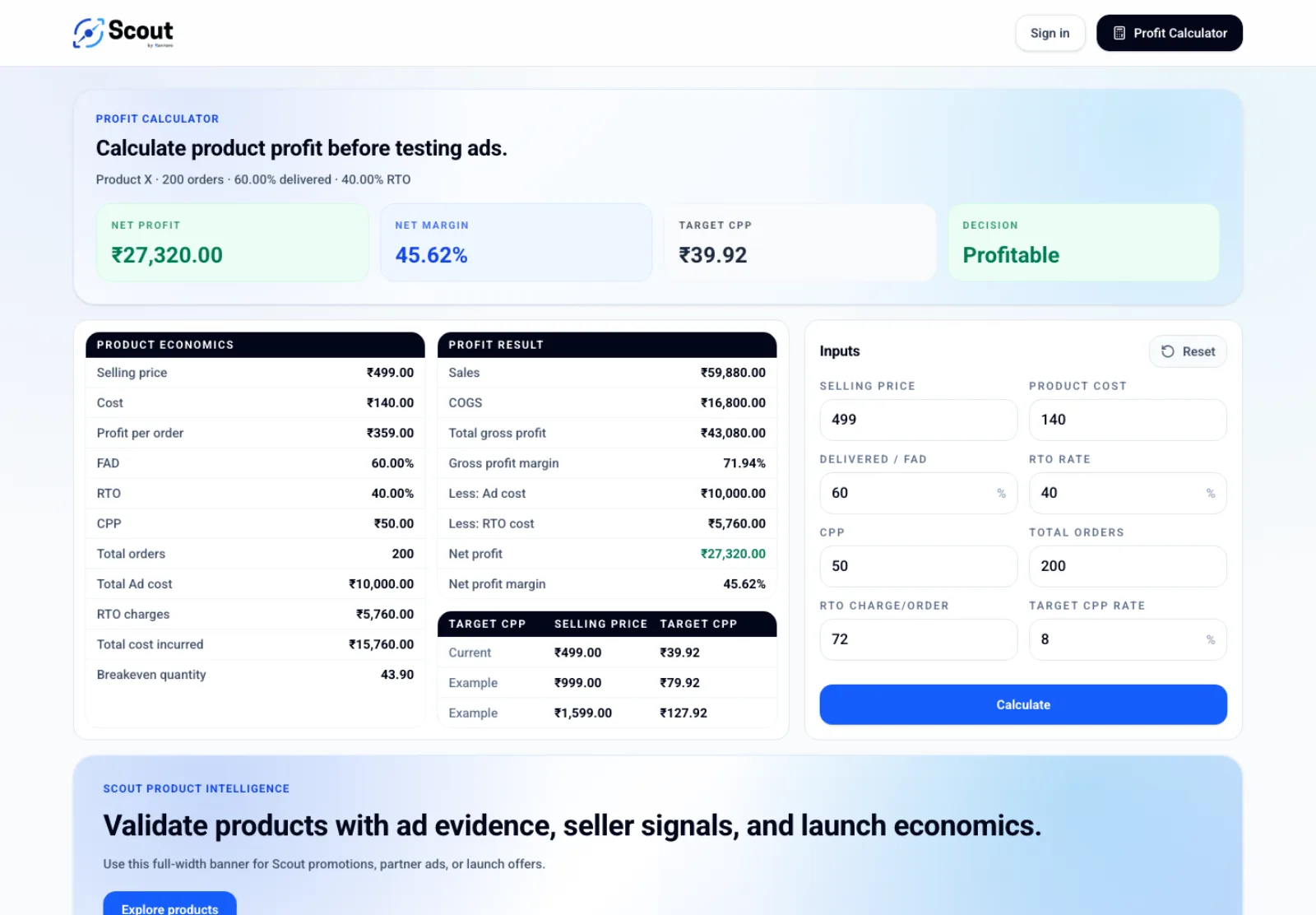
Estimate contribution before advertising using collected revenue, supplier and fulfilment costs, payment fees, returns, RTO, and support allowance. The remaining amount is not automatically your target cost; the business may still need overhead and profit.
Use conservative assumptions and the Scout profit calculator. Create an expected ceiling and a harder stop ceiling. If the economics leave almost no acquisition room, more advertising budget will not repair the product.
Budget for creative learning
The advertisement is part of the hypothesis. Allocate time and money for original, truthful creative that demonstrates the product clearly. One weak copied asset is not a fair test of the product, while dozens of variations can create unnecessary cost.
Begin with a small set of meaningfully different concepts: different problems, demonstrations, or audiences—not only different colours and captions. Record which question each creative answers.
Include operational outcomes
Ad-platform purchases are early signals. For COD, track confirmation, shipment, delivery, collection, and RTO. For every payment method, track cancellation, return, replacement, and support burden.
The test window must allow enough time for these outcomes to mature. A campaign can look attractive on day one and become uneconomic after delivery results arrive.
Define stop conditions in advance
Examples include:
- Spend reaches the agreed learning limit without sufficient qualified response
- Cost per collected order exceeds the stressed ceiling
- Confirmation or delivery quality is materially weaker than assumed
- Creative attracts the wrong customer or creates expectation mismatch
- Supplier quality or fulfilment reliability fails
- Compliance or claim concerns emerge
Stop conditions prevent hope from converting a controlled test into unbounded spending.
Define continuation conditions
Continuation should require more than cheap clicks. Look for a coherent path from attention to delivered contribution. The exact threshold depends on price and expected conversion volume, but evidence should include customer fit, order quality, and operational feasibility.
If results are promising but incomplete, run a second controlled test with one clear change. Do not immediately scale several variables.
Preserve a learning record
Document the product version, offer, page, creatives, audience, dates, spend, funnel events, delivery outcomes, costs, and conclusion. Include what would change your mind.
This creates reusable knowledge even when the product fails. Without a record, teams repeat the same test under a new name.
Treat the budget as risk capital
Use money the business can afford to lose and consider cash-flow timing, especially for COD. Advertising outcomes are uncertain, and platform metrics are not financial guarantees.
Scout can help select a better-researched candidate and expose important assumptions. The budget remains a business decision that should be reviewed against your own finances and, where appropriate, qualified professional advice.