
How to Calculate Dropshipping Profit Margins in India
Build a realistic dropshipping margin model using collected revenue, product cost, shipping, payment fees, ad spend, returns, COD, and RTO.

The common calculation “selling price minus supplier price” is not profit. It ignores the cost of finding the customer, delivering the order, collecting payment, supporting the buyer, and absorbing unsuccessful fulfilment.
Before testing a product, build a contribution model that reflects how money actually moves.
Begin with collected revenue
For prepaid orders, account for successful payment, cancellation, refund, and return outcomes. For COD orders, separate placed orders from delivered and collected orders.
Use revenue net of discounts, refunds, and taxes handled outside the selling price. If you are unsure how taxes apply to your business, obtain qualified accounting advice rather than copying a competitor’s model.
Include variable product and fulfilment costs
Record every cost that changes with an order:
- Supplier or purchase cost
- Packaging and inserts
- Forward shipping
- COD or payment-processing fee
- Platform or transaction charge
- Pick-and-pack or fulfilment fee
- Customer support allowance
- Expected replacement and return cost
- RTO and reverse-logistics cost
Supplier price is only one component. Verify whether quoted shipping and fees include taxes, zones, weight adjustments, and reverse movement.
Allocate advertising to outcomes
Advertising platforms report clicks, conversions, and attributed purchases. Your margin model needs cost per collected outcome.
Divide total relevant ad spend by the number of orders that ultimately deliver and remain valid after the measurement window. Early campaign reporting can overstate performance because delivery and returns are incomplete.
Creative production and agency costs may also belong in the test or monthly operating model, depending on how you use the calculation.
Use expected-value allowances
Not every order incurs an RTO or return cost, but ignoring those outcomes makes every delivered order look more profitable than it is. Estimate expected cost across the cohort.
For example, multiply the number of affected orders by their average forward and reverse cost, then spread that amount across collected orders. Use your supplier and courier terms; do not rely on a universal rate.
Calculate contribution and margin
Contribution per collected order is collected revenue minus allocated variable product, advertising, fulfilment, payment, return, and RTO costs.
Contribution margin percentage is:
Contribution per collected order divided by collected revenue, multiplied by 100.
This is not necessarily net business profit. Salaries, software, office costs, taxes, damaged inventory, content production, and other overhead may still need to be covered.
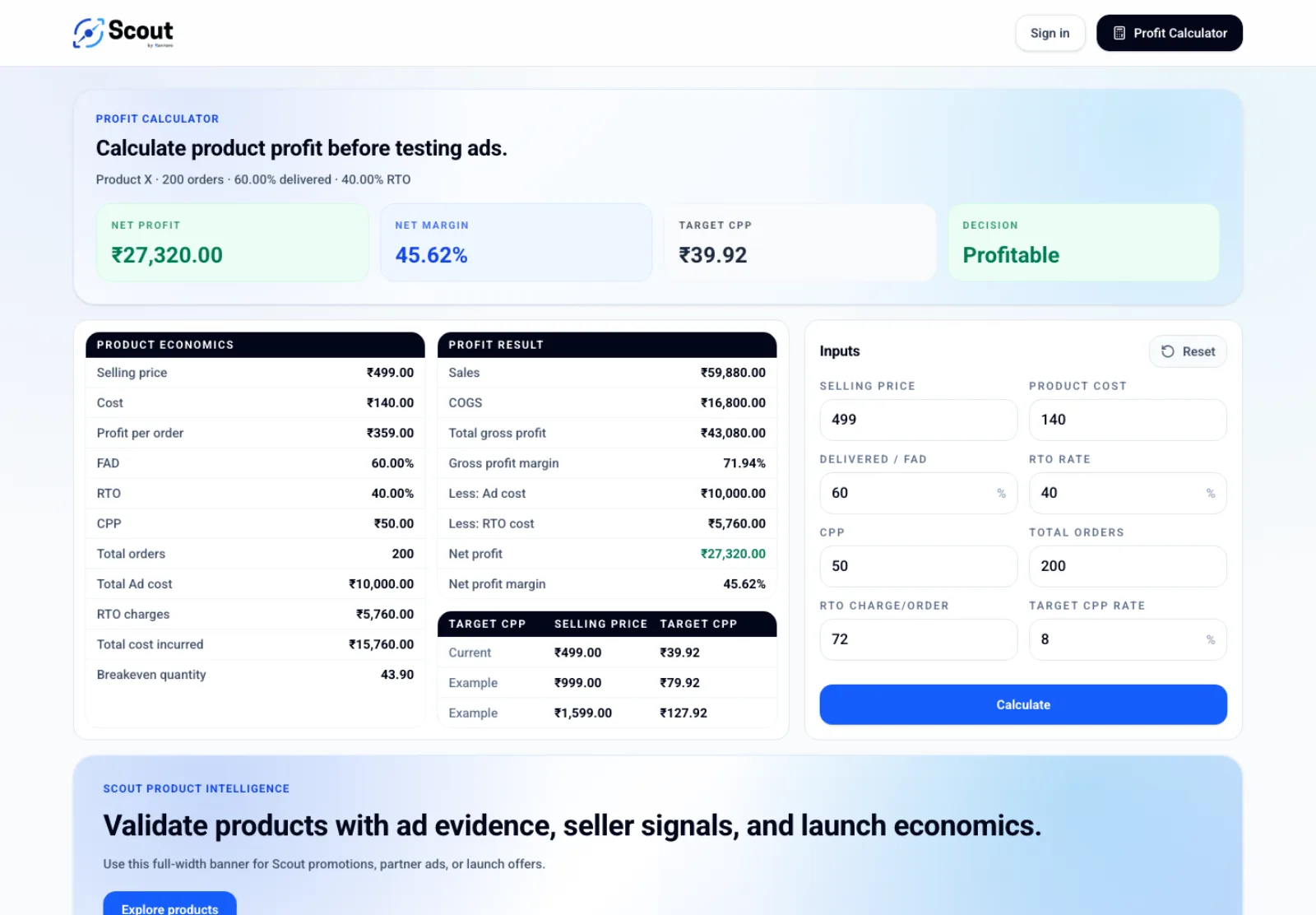
Try the Scout profit calculator to compare optimistic, expected, and stressed assumptions.
Run sensitivity checks
Change one input at a time:
- Increase cost per purchase.
- Increase RTO or return rate.
- Add a remote-zone shipping allowance.
- Reduce selling price for a realistic promotion.
- Include replacement and support cost.
Notice which variable destroys contribution first. That is the metric your test must watch closely.
Compare products on resilience
A high headline margin can be fragile if the item breaks, needs sizing support, or faces high customer expectation mismatch. A modest margin with predictable delivery and clear value may be easier to operate.
Compare candidates using the same model and confidence level. Do not assign precise costs where information is unknown; use a conservative range and mark the uncertainty.
Decide before spending
Set the maximum acceptable acquisition cost and stop conditions from the stressed model. During the test, update estimates with confirmed, shipped, delivered, returned, and collected outcomes.
The purpose of the calculation is not to forecast perfectly. It is to expose which assumptions must be true and prevent order volume from being mistaken for profitable growth.