
How to Analyze a Dropshipping Competitor Store
Learn how to examine a competitor store's positioning, assortment, offers, advertising activity, trust signals, and operational expectations responsibly.

A competitor store is a valuable public research source, but it is not an open financial statement. You can observe products, prices, offers, copy, policies, and linked advertising activity. You generally cannot verify sales, margins, customer acquisition cost, or profitability.
The goal is to understand the market’s visible choices and find a responsible way to improve the customer experience—not to copy the store.
Confirm that the store is relevant
First establish whether the store serves a comparable customer and sells the same or materially similar product. A global brand, marketplace seller, and generic reseller may all appear in search results but represent different business models.
Check the domain, market served, currency, delivery coverage, assortment breadth, product branding, and whether the product is central or incidental. Keep global examples as creative or positioning context; do not present them as evidence of Indian demand.
Map the store's positioning
Read the homepage, collection, product page, FAQ, and policy pages. Summarise the promise in one sentence. Is the store competing on price, convenience, expertise, identity, gifting, premium quality, or a narrow use case?
Note who the copy addresses and which problem receives the most space. The strongest positioning is often revealed by what the store repeats across pages.
Break down the product offer
Record observable facts:
- Listed and selling price
- Product quantity and variants
- Bundles, gifts, and discounts
- Delivery and COD statements
- Guarantee or return language
- Instructions and compatibility details
- Visible stock wording and observation date
Do not assume a crossed-out price was previously charged or that an “in stock” label reflects live inventory. These are store claims observed at a point in time.
Examine the assortment
A focused store may build trust around one audience or problem. A broad generic assortment may depend more heavily on advertising and individual product pages.
Look for repeated suppliers, visual styles, unrelated categories, product naming consistency, and whether items appear store-branded or manufacturer-branded. These clues can help classify the business, but no single clue proves that it is a dropshipping operation.
Connect the store to advertising evidence
When a reliable page identity is available, examine current relevant ads associated with that advertiser. Match destination product, creative, and offer carefully. One advertisement can include several cards or destination links, so product association must not be inferred from the advertiser alone.
Compare ad hooks with landing-page promises. A consistent journey may reduce confusion; a mismatch may reveal customer-experience risk.
Review trust and operational expectations
Observe contact options, business identity, policy clarity, delivery estimates, payment options, reviews, FAQs, instructions, and support promises. Do not treat the presence of these elements as proof they are fulfilled.
Ask what operational standard a customer entering from the ad will expect. If competitors promise detailed support or easy replacement, your cost model must reflect an equivalent or better experience.
Identify gaps without copying
Create a comparison table for customer, promise, proof, demonstration, offer, objections, service, and price. Highlight gaps you can address originally and truthfully.
Avoid copying photographs, videos, page layouts, reviews, or wording. Beyond legal and ethical concerns, imitation prevents you from learning why your own offer works.
Turn observations into test hypotheses
Choose one meaningful difference and define how you will test it. Combine competitor research with independent demand evidence and your own economics. A beautiful store with many ads can still lose money; a basic store can still serve a profitable niche.
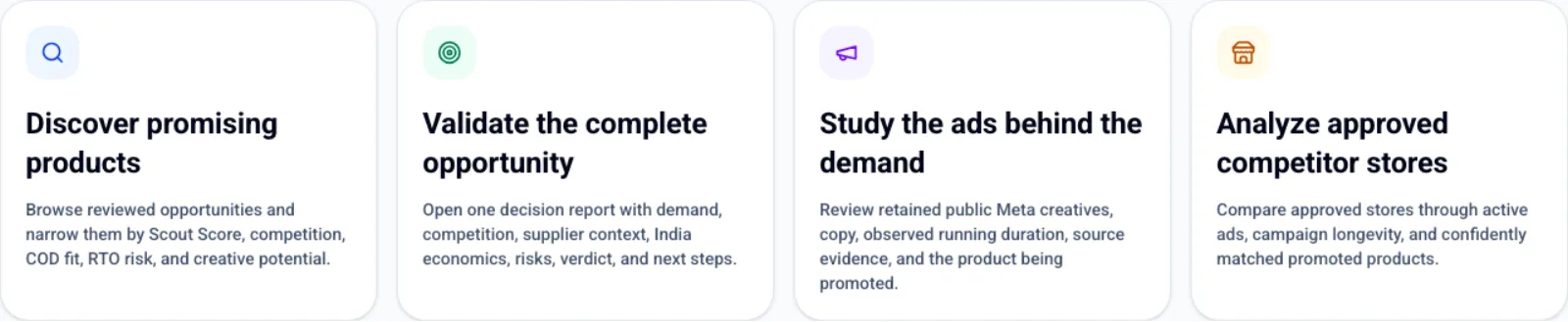
Scout’s competitor intelligence is designed to organise observed activity and product context. It supports comparison, not claims about another business’s private performance.